Organic Modern
Living Room
A room that breathes.
Layered, not loaded.
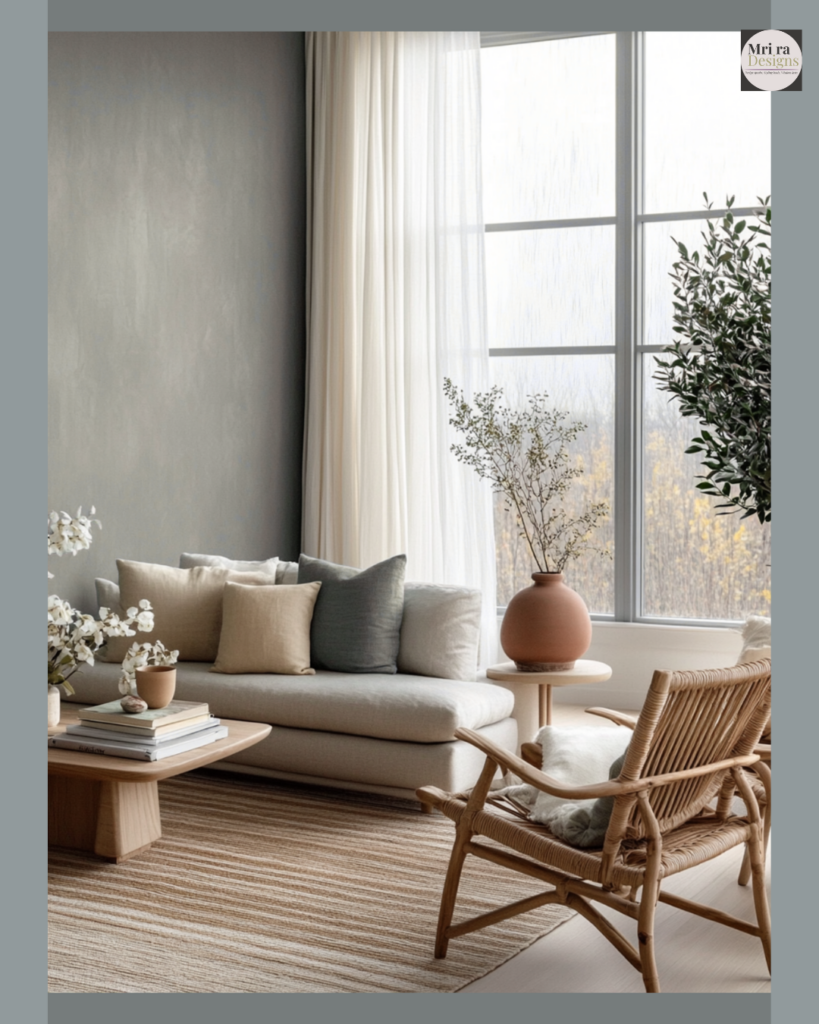
This is not about buying more. It is about choosing right, placing with intention, and letting every element earn its place. The organic modern living room lives in the quiet tension between raw and refined — jute against linen, rattan against plaster, terra cotta against sage. It is a room that feels lived-in on day one.
“Layering in interiors is the difference between a room that looks decorated and one that feels inhabited.”
The completed look — Edition 2 · Layering in Interiors · mriradesigns
What goes into
this room
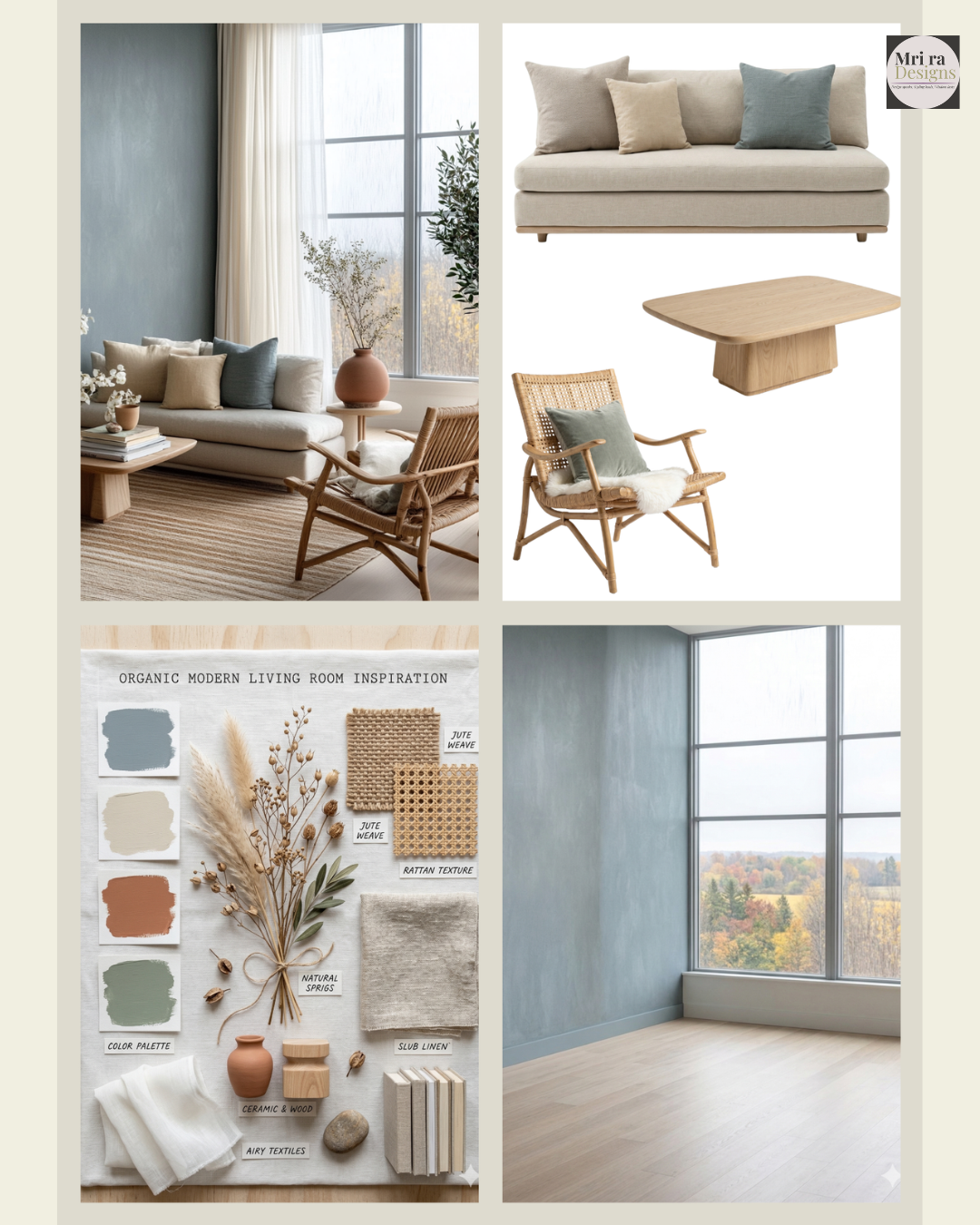
Every element here has a role. The colour palette anchors the mood. The furniture pieces define the structure. The textures — jute weave, slub linen, rattan, ceramic — are what make it feel warm rather than cold, curated rather than staged.
Mood board — furniture, palette and textures at a glance
Layer by layer —
build this room
Follow this sequence. Each step builds on the last. Resist the urge to jump ahead — proportion and layering only work when you let each element settle before adding the next.
| Step | What to do | |
|---|---|---|
| 🎨 | Walls first | Dusty blue-grey limewash or matte paint. This is your 60% dominant colour — get it right before anything else moves in. |
| 🪵 | Anchor with a rug | Jute weave, neutral stripe. Lay it down and define your seating zone before a single piece of furniture arrives. |
| 🛋️ | Place the sofa | Low-profile, linen, off-white. Keep the legs visible — it lifts the room visually and prevents the space from feeling heavy. |
| 🪑 | Add the rattan chair | Place it diagonally to the sofa. Breaking symmetry is what separates a styled room from a showroom. |
| 📐 | Coffee table | Solid wood, pedestal base. Low and wide gives you grounded energy without heaviness. Should be half the sofa’s length. |
| 🧶 | Layer textiles | Mix slub linen cushions with one sage or dusty blue accent. Maximum four cushions — any more and the sofa disappears. |
| 🏺 | Style the table | One tall terracotta vase and one small ceramic vessel. Odd numbers always read as intentional. Even numbers look like they’re waiting for something. |
| 🌿 | Add life | One tall indoor tree — olive or ficus — and one dried stem arrangement. Plants bring the one thing furniture cannot: scale that breathes. |
| ☀️ | Let light breathe | Sheer floor-length curtains only. Pull them back fully during the day. Natural light does more work than any accent lamp. |
Your sofa should span two-thirds the width of your main wall. Your coffee table should be half the length of your sofa. When in doubt, go smaller on the table — you can always add a tray to fill the surface.
The rules of
proportion
Furniture that is too large crowds a room. Too small, and it floats. These ratios are your starting point — not a rigid formula, but a reliable anchor.
Your sofa should fill roughly two-thirds of the wall it sits against. This leaves enough breathing room on both sides.
Coffee table length should be approximately half your sofa. Allows you to reach it comfortably without it dominating.
Keep the coffee table within 6 to 8 inches of your sofa seat height. Too low feels like floor living; too high feels formal.
Leave at least 18 inches between your sofa and coffee table. Enough to move, enough to feel open.
60% dominant (walls + rug), 30% secondary (sofa + large pieces), 10% accent (cushions, vases, plants).
Style in groups of three. Odd numbers feel organic and curated — even numbers feel like a matching set from a catalogue.
Get this look —
budget guide (India)
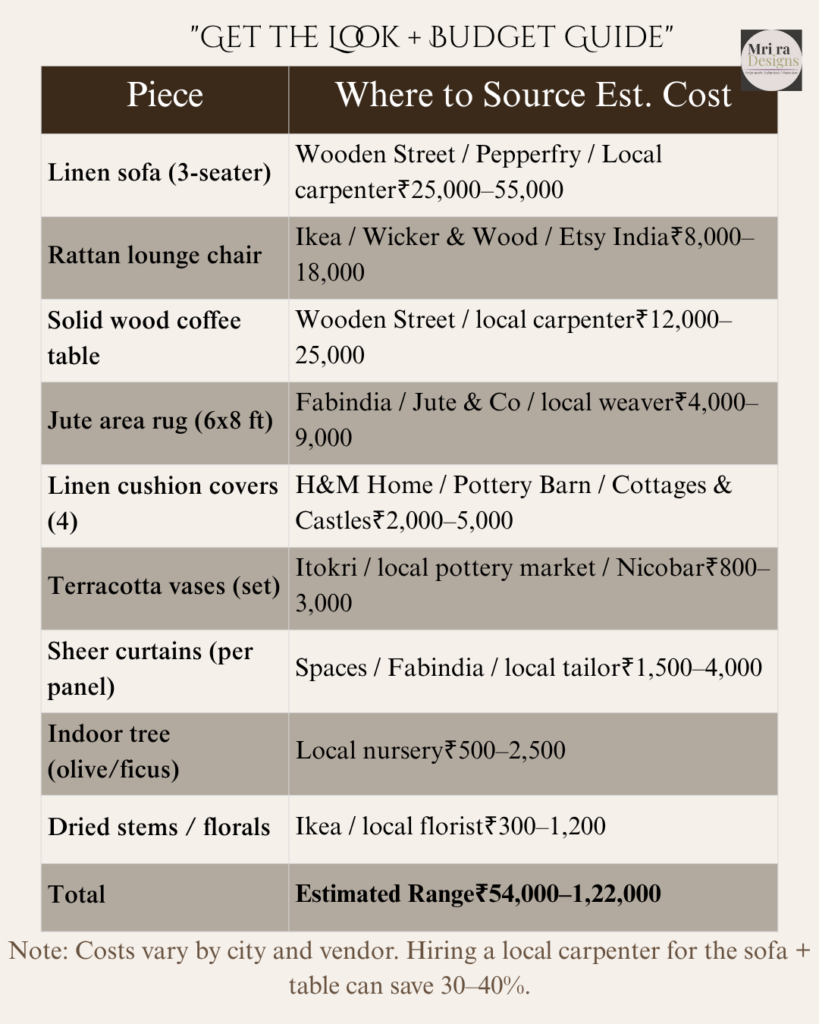
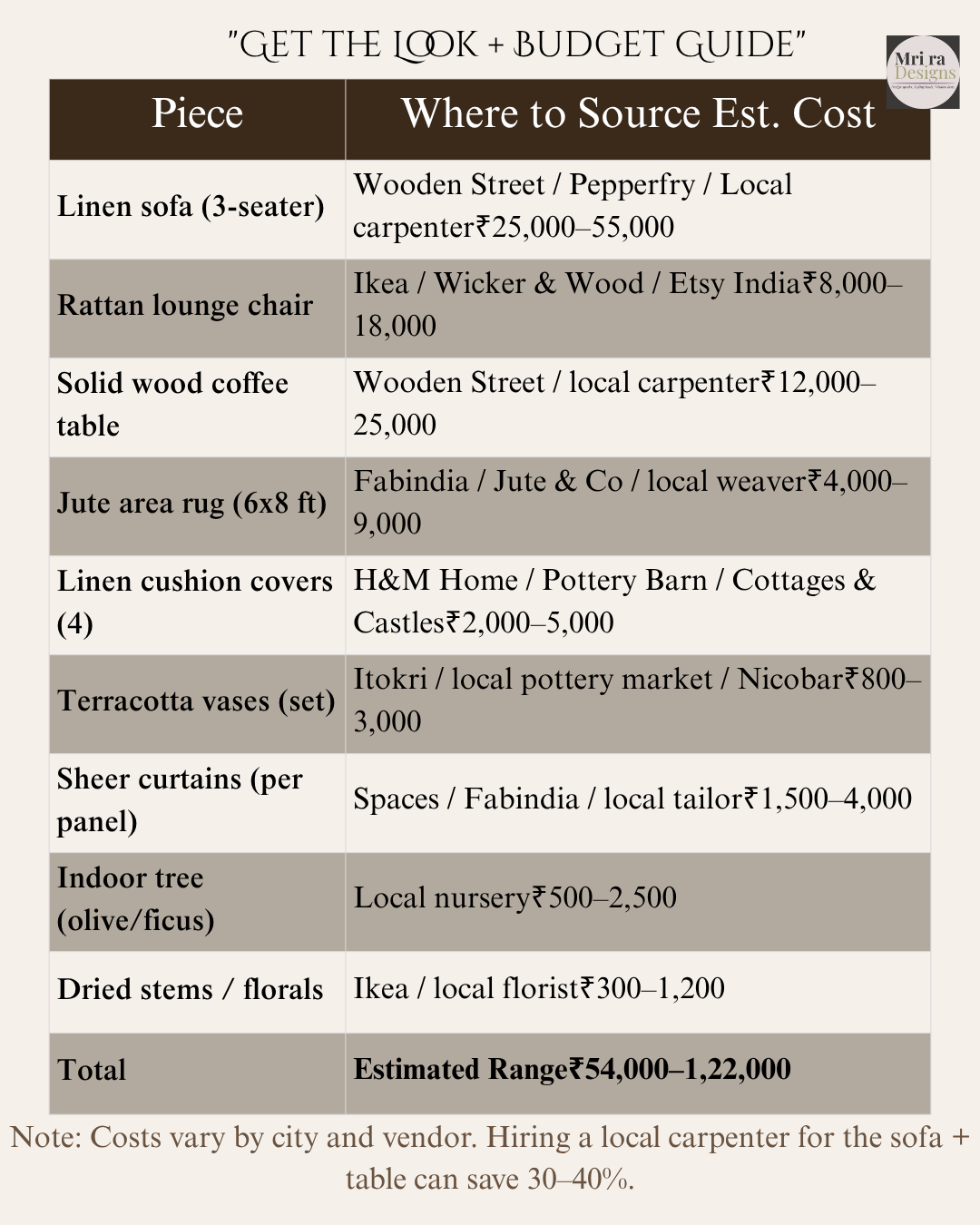
All prices are approximate and vary by city, vendor, and availability. Local carpenters and artisan markets can reduce costs significantly — notes below where this applies.
| Piece | Where to source | Est. cost (₹) |
|---|---|---|
| Linen sofa, 3-seater | Wooden Street · Pepperfry · Local carpenter | ₹25,000 – 55,000 |
| Rattan lounge chair | Ikea · Wicker & Wood · Etsy India | ₹8,000 – 18,000 |
| Solid wood coffee table | Wooden Street · Local carpenter | ₹12,000 – 25,000 |
| Jute area rug, 6×8 ft | Fabindia · Jute & Co · Local weaver | ₹4,000 – 9,000 |
| Linen cushion covers (set of 4) | H&M Home · Pottery Barn · Cottages & Castles | ₹2,000 – 5,000 |
| Terracotta vases, set | Itokri · Local pottery market · Nicobar | ₹800 – 3,000 |
| Sheer curtains, per panel | Spaces · Fabindia · Local tailor | ₹1,500 – 4,000 |
| Indoor tree (olive or ficus) | Local nursery | ₹500 – 2,500 |
| Dried stems and florals | Ikea · Local florist | ₹300 – 1,200 |
| Total estimated range | ₹54,000 – ₹1,22,000 | |
Carpenter tip: Commissioning your sofa and coffee table from a local carpenter can save 30–40% versus retail. Bring the reference images from this guide and specify dimensions precisely using the proportion rules above.